
Cook
Easy Is the Problem: Green Bean Casserole

Food Is Food
That’s what we tell ourselves.
We say it when we’re worn out and just need to get through dinner. Food is food becomes a way to stop thinking.
And that’s a mindset the ultra-processed food industry is very good at exploiting.
Easy Steals the Choice
Ultra-processed food didn’t take over because it was better. It took over because it was easier.
Easier to get. Easier to repeat. Easier to say yes to without thinking much about it. Over time, that ease stopped being a bonus and started doing the deciding.
Eventually, it doesn’t feel like a choice anymore. It feels like preference, but it’s really just the default.
That didn’t happen by accident. That’s how it was designed to work.
The Cost
The cost of easy food doesn’t always show up right away.
Sometimes it shows up in your body, slowly, over time. Other times it’s quieter. You’re not hungry anymore, but you don’t quite feel done. You ate, but it didn’t really count.
Because it wasn’t honest food. It didn’t ask anything of you, and it didn’t give much back. It looked like care, but it wasn’t. It filled space without actually satisfying.
That feeling isn’t confusion. It’s recognizing the difference between something real and something pretending.
Where the Default Breaks
There’s usually a moment when the pattern becomes visible again.
Not as a call to change everything, but as a simple realization that the decision has been happening on autopilot. What felt like preference turns out to be habit.
That pause matters. It doesn’t demand extremes. It just creates space to decide again.
Green Bean Casserole as a Case Study
Green bean casserole works here because the default version is almost entirely ultra-processed.
The usual recipe is mostly opening cans. Canned green beans. Canned soup. Fried onions from a can. Mix, bake, done. The choices were already made.
That makes it a good place to interrupt the cycle. When a dish is that outsourced, even a few intentional changes are enough to put you back in the process.
What Changes, What Stays
In this version, some defaults are interrupted.
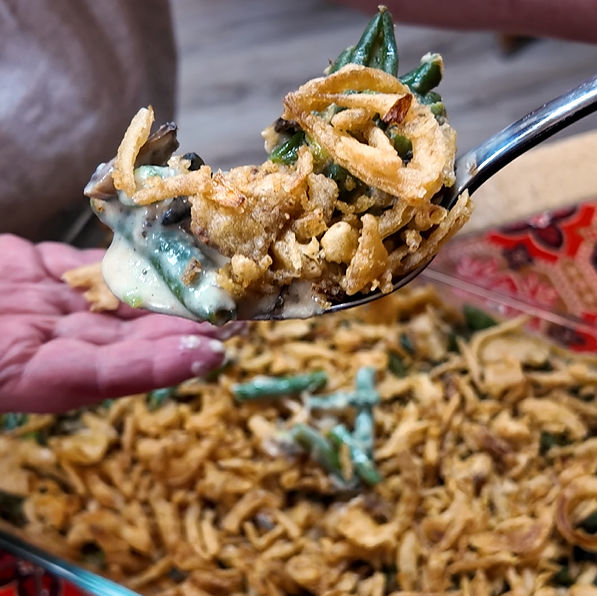
Fresh green beans replace canned. A real mushroom sauce replaces canned soup. The foundation shifts back toward recognizable food.
And then it stops.
I have limits.
The fried onions stay. They are the essence of the dish. Removing them would create something else entirely.
That choice isn’t accidental. It’s specific.
What this Demonstrates
Some things are worth changing. Some things are fine to leave alone.
What matters is knowing which is which, instead of letting everything happen by default.
When you make even a few choices on purpose, you’re back in the driver’s seat. It doesn’t have to be perfect to count.
The Takeaway
Ultra-processed food has the upper hand when you don’t notice it.
When you pause and make a decision, even a small one, that grip loosens. Not because the system changed, but because you did.
You don’t have to get it right every time. You just have to stop letting everything be decided for you.
Ingredients
Method
- Heat oven to 350°F.
- Steam green beans until just tender; drain well.
- Brown mushrooms in oil over medium heat until moisture cooks off.
- Add butter, then flour; cook briefly. Whisk in milk and bouillon. Simmer until thick. Stir in black pepper.
- Combine green beans and sauce. Transfer to a 9×13-inch baking dish.
- Bake 30 minutes. Top with entire can of french fried onions and bake 5–10 minutes more, until golden.
Notes
- To skip canned french fried onions, thinly slice a sweet onion, toss lightly with oil and a pinch of salt, and air fry at 375°F until golden and crisp, shaking halfway through. Watch closely at the end; they brown quickly.