
Grow Cook Eat
Raising Real Eaters: Dessert Is Not the Prize
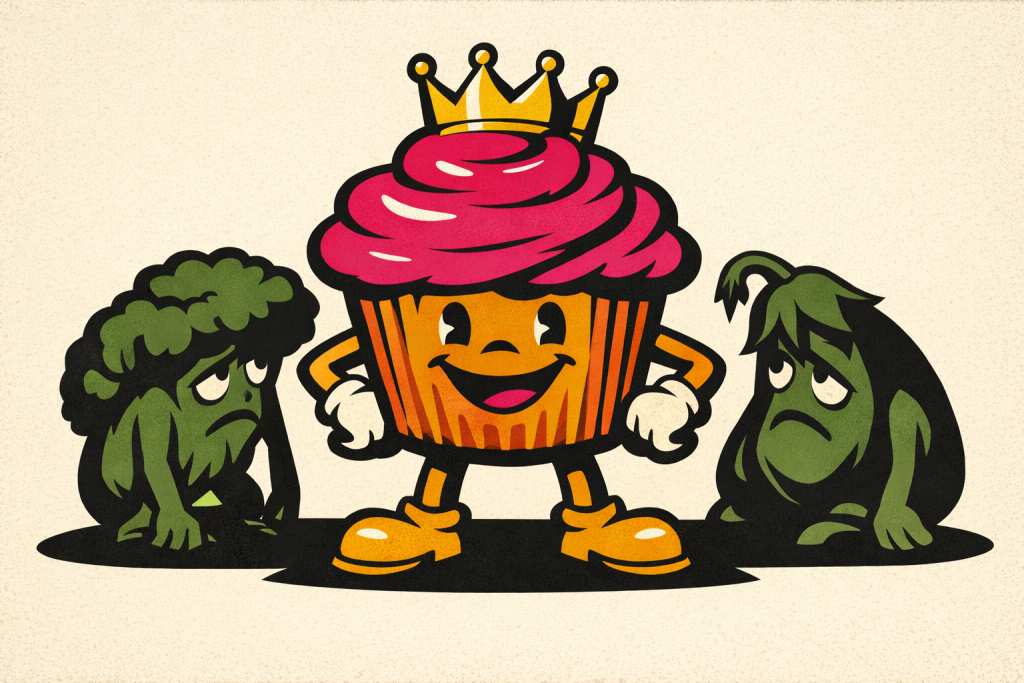
Part 2 in a series on feeding children real food: Raising Real Eaters
Post one was about the two goals of feeding a child: nourish the body in front of you today, and build the person who feeds themselves well for the next fifty years. This post is squarely about that second job.
Because here’s a sentence nearly every parent has said: “Eat your vegetables and you can have dessert.”
It sounds completely reasonable. It’s also quietly teaching the opposite of what you want.
What That Sentence Actually Says
To a child, the translation is simple. Real food is the toll. Dessert is the destination.
Say it enough and it sets. Vegetables become the thing to get through. Dessert becomes the thing worth wanting. The food that matters most ends up dead last in the rankings.
This isn’t a bad-parent problem. It’s a habit so ordinary nobody stops to question it.
The Better Way: It’s All Good
The healthiest approach is also the simplest. The protein, the vegetable, the dessert. Same team. Nothing is the enemy. Nothing is the trophy.
When nothing on the plate carries extra meaning, nothing on the plate gets fought over. A child raised this way doesn’t beg for dessert, because nobody ever turned dessert into something worth begging for.
For some people, the pull toward sugar runs stronger than for others. That’s real, and it’s worth naming. Which is exactly why the early framing matters so much. The goal was never willpower. The goal is to never build the craving in the first place.
It’s Not Too Late if You’re Starting Later
Maybe this wasn’t how things began at your house. Maybe a few habits already took root. The angling. The negotiating. The running tab of who promised what.
Here’s the encouraging part: this can still be taught. Older kids and teenagers are fully capable of updating how they think about food, especially once they understand there’s a reason behind it. Food tastes good. Some food tastes better than other food. But food also has a job, which is fueling a body that has to grow, move, and feel good.
Holding both of those ideas at once is a more grown-up way to eat. It’s never too late to hand a child that idea.
That conversation isn’t a lecture. It’s an invitation to take the wheel.
This One’s for You Too
If dessert still feels like something you earn, or something you have to white-knuckle past, that’s the same childhood program, just running on adult hardware now.
You can update it. Food doesn’t have to be a reward or a rule. Sometimes food is just food.
What to Do with This
Serve dessert like it’s just another food. Because it is. Put it out sometimes, no speech attached, no strings to the dinner plate.
Stop making it the finish line. “Eat three more bites and you can have it” turns broccoli into a tollbooth. Drop the toll.
Give a reasonable portion and let that be it. A few cookies, a scoop, a handful. Not a reward for good behavior. Not a consolation prize. Just the amount.
Keep that portion small enough that it can’t replace a meal. Eating dessert first is fine, this isn’t about order. As long as the meal is still on the table, they’re welcome to circle back to it.
The natural consequence kicks in later. If a child fills up on a small dessert, skips the meal, and the table gets cleared, the kitchen is closed until next time. Hunger shows up an hour later and they get to sit with that decision. They tend to plan differently next time. That’s not a punishment. It’s natural consequences doing the teaching for you.
Let it be normal. Dessert that shows up regularly stops being a big deal. The big deal is what creates the begging.
With older kids, say the quiet part out loud now and then. Food fuels a body, and part of that job is simply putting a stop to hunger. That’s not a lecture, it’s just true, and they can handle the truth.
And when the cookie happens, or the drive-through happens, or the birthday party turns into a sugar bender? Let it go.
One plate never built a habit. Neither did one bad day. What you do at home, most of the time, is the whole game.