
Grow Cook Eat
Raising Real Eaters: Who Taught You to Eat Like That?
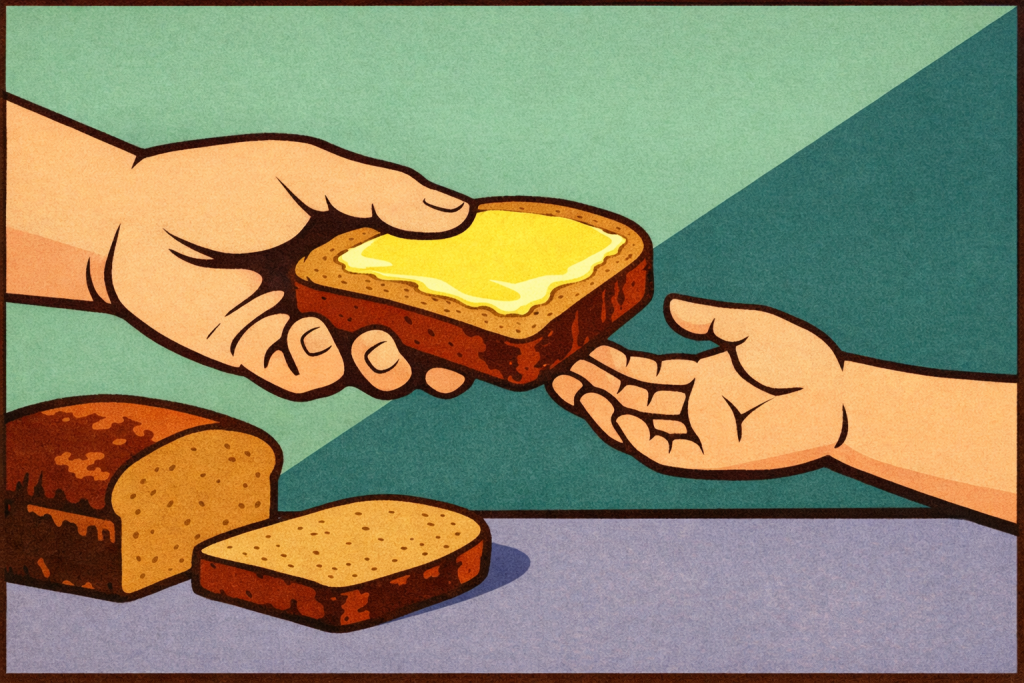
Part 5 in a series on feeding children real food: Raising Real Eaters
This series has been about feeding children.
It has also, the entire time, been about you.
Every post had a section aimed at the adult reading it. That wasn’t a bonus. That was the point surfacing a little at a time, and it’s time to say it plainly.
You Were Raised Too
Whatever you believe about food right now, you learned it somewhere.
Your preferences. Your rules. The foods you won’t touch and the ones you reach for when the day goes sideways. The voice that scores your eating as good or bad.
Most of it was installed before you were old enough to consent to any of it. You watched the adults around you eat, and you absorbed what was normal in that house, what got celebrated, what got used as comfort.
Some people inherit an easy relationship with food. Plenty inherit something heavier. The binge and the guilt behind it. The constant mental math about what was eaten and what it cost. Eating that has nothing to do with hunger and everything to do with the day you had.
That’s real, it’s common, and most people carrying it have never traced it back to where it started.
The Questions Worth Asking
Here’s the useful work. Sit with a few of these and see what surfaces.
- Why do my foods have to stay separate and not touch?
- Why do I finish everything on my plate even when I’m full?
- Why do I feel like I should never empty my plate, that I have to leave a bite?
- Why does a bad eating day feel like a moral failure?
- When did I last actually try the thing I say I don’t like?
- Why do certain foods have to stay out of the house entirely?
Some have easy answers. Some have no answer at all, which is its own information.
What You Do with it Now
You didn’t pick what got installed. You do pick what happens next.
Some of this is correction. You never learned to cook a vegetable properly, so you learned to hate vegetables. Fixable in an afternoon.
Some of it is discipline. You know what you should be doing and you’ve been choosing otherwise. Also fixable, less pleasantly.
And some of it needs more patience than that, and more grace than you’ve been giving yourself. Habits laid down over decades don’t lift in a week. They lift the way they went in, gradually, through repetitive maturity.
The tools are the same ones this series has been handing you. Nothing on a pedestal. Nothing forbidden. Protein first. Food that tastes good because someone bothered. Repetition without ceremony.
Those work on a four-year-old. They work on a forty-year-old. The four-year-old just gets a head start.
Privilege and Responsibility
You are, right now, deciding what a child carries into their forties. Their defaults. Their comfort foods. Whether food is a source of pleasure or a source of anxiety. Whether they can eat a handful of something and put the bag down.
That’s the responsibility. It’s easy to hear it as pressure, but it isn’t. It’s leverage. Nobody else in that child’s life has this much influence, and you have it right now, whether you use it deliberately or not.
The privilege is what comes with it. You get to decide what stops here. Whatever you were handed, the rules you can’t explain, the guilt, the foods you learned to fear, none of it has to continue past you. You are standing at the exact point where an inheritance either passes through or gets rewritten.
Not everyone gets a chance to break something and rebuild it in the same lifetime. You do, and you’re doing it over dinner every weeknight.
What it Looks Like When it Works
My youngest son is grown now. Somewhere along the way he built himself a system, on his own, without being asked.
Growing up, he knew the deal. Everything on the plate gets eaten. Which meant he ran into a problem: by the time he’d worked through what he liked, the hunger was gone and the vegetables were still sitting there, harder to get down than they’d been ten minutes earlier.
So he flipped it. He loads his plate, then eats one thing at a time until it’s gone before moving to the next, starting with whatever he likes least and working toward his favorite. He front-loads the hard part while the hunger is still there to do the work.
Here’s the part that tells you it took. He’s grown. Nobody is making him finish anything. And I still watch him build a plate with some of everything on it, including the things he’s never been fond of, because he understands he’s the one responsible for his own health now.
I never taught him that. I spent years putting real food on the table without ceremony, holding the line, and letting hunger and repetition teach what a lecture never could.
This is what you’re actually building. Not a person following rules I gave him, but a person who thinks about his own nourishment on purpose and solves for it.
That’s the goal. Not obedience. Ownership.
Most of the Time is Enough
None of this asks for perfection, from your kids or from you. The drive-through happens. The birthday cake happens. The week where dinner is whatever anyone can find happens. And we love it. Variety and fun in life are always fitting.
One meal never built a habit. One bad week never undid one either.
What you do at home, most of the time, is the whole game. That’s the standard.
Start where you are. Keep going. That’s enough.
Which one of those questions landed hardest? Drop it in the comments. And did you find anything underneath it?